
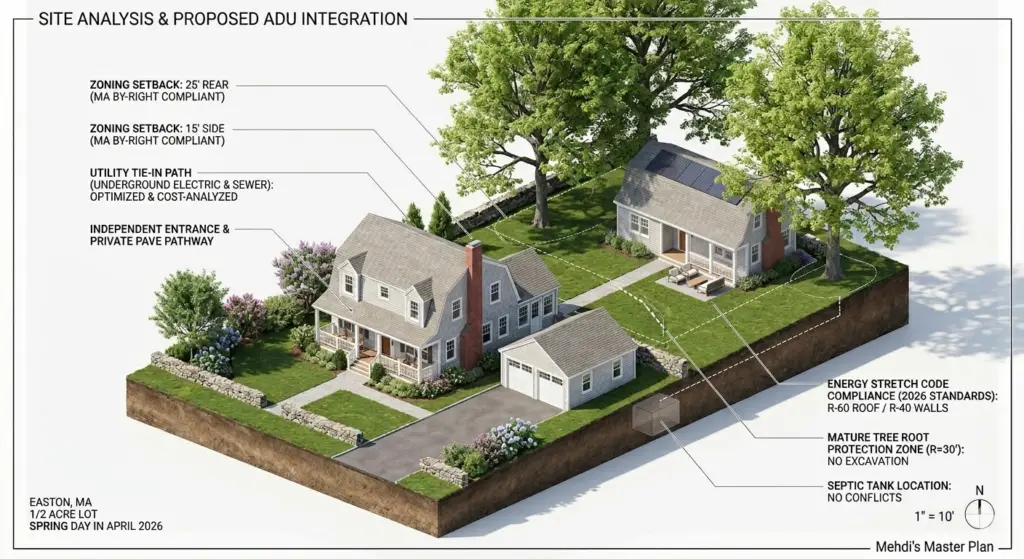
For decades, adding a second unit to your property in Greater Boston was a zoning nightmare. The ability to add an ADU is changing the rules of the game. Whether you’re looking to house a grandparent, give a adult child a head start, or build a high-yield rental, your backyard is officially open for business, but “permitted by right” doesn’t mean “easy to build”
1. Decoding “By-Right” (The 2026 Rules)
Under the Affordable Homes Act, Massachusetts has streamlined the path for Accessory Dwelling Units (ADUs). If you own a single-family home, you likely have the right to build a unit up to 900 square feet (or 50% of the main house’s size, whichever is smaller) without a special permit.
- The Catch: Local towns still control “reasonable” dimensional regulations. This means your “Master Plan” must still account for side and rear setbacks (often 15–25 feet in many towns) and maximum lot coverage ratios.
- The Parking Myth: In many transit-oriented “First-Ring” corridors, you are no longer required to provide additional off-street parking for an ADU. This is a massive win for smaller lots in places like Salem or Lynn.
2. The Infrastructure Audit: Sewer, Water, and Power
This is where the “Builder’s Eye” saves you thousands. You aren’t just building a box; you’re tapping into an existing ecosystem.
- Septic vs. Sewer: If you’re on a septic system (common in the South Shore), your current tank is likely sized for a specific number of bedrooms. Adding an ADU often requires a Title V upgrade or a specialized secondary treatment system.
- Utility Tie-ins: Running a new sewer line or electrical sub-panel 100 feet into your backyard involves significant trenching. We map these routes to avoid mature tree roots and existing ledge—two of the biggest “budget-killers” in Massachusetts construction.
3. Meeting the 2026 Energy Stretch Code
Massachusetts has some of the strictest energy codes in the country. A modern ADU must be built as a “high-performance envelope.”
- Thermal Bridging: We utilize advanced framing and continuous insulation to meet the new R-value requirements (typically R-60 for roofs and R-40 for walls).
- All-Electric Mandates: Many local municipalities now require new builds to be all-electric. This means planning for high-efficiency heat pumps (mini-splits) and induction cooking from day one.
4. The Wealth Preservation Strategy
The average cost of assisted living in Massachusetts has climbed toward $7,500/month.
- ROI Calculation: Investing $250k–$350k in a high-end ADU might seem steep, but when compared to the 10-year cost of a senior living facility ($900k+), the ADU pays for itself three times over while keeping family wealth in the form of real estate equity.
- The Valuation Lift: Appraisals for properties with legal ADUs are finally catching up. In a tight market, a “move-in ready” multigenerational setup is a major differentiator that commands a premium.
The Bottom Line: Your backyard is an untapped asset, but the margin for error is thin. Don’t just hire a contractor to build a structure—hire a strategist to build a future.
Reach out now for a free consultation! I can help you identify opportunities to acquire, build, or convert properties for ADUs.