
If you are navigating the Massachusetts housing market right now, you can feel the ground shifting beneath your feet. We have officially moved past the pandemic-era mania of blind bidding wars and “as-is” waivers.
As a Realtor who looks at property through a builder’s lens, I don’t just track list prices—I track the structural and legislative machinery that creates long-term value. Right now, two massive forces are converging on the South Shore: a dramatic market recalibration and a high-stakes legislative battle over statewide rent control.
Here is the data, the policy breakdown, and the exact strategy you need to navigate both.
1. The Market Reality: The Re-Emergence of the Home Inspection
First, let’s look at the transactional data. The frantic “buy at all costs” energy of the last few years has hit a wall.
- The Numbers: Nearly 50% of active listings in Massachusetts have seen price adjustments before going under agreement. Only about 23% of properties are closing over their original asking price.
- The Shift: With interest rates stabilizing in the low 6s, inventory is slowly trickling back into the market. Buyers are no longer willing to inherit a previous owner’s deferred maintenance. They are demanding home inspections, pushing back on older roofs, and forcing a flight to quality.
- The Strategy: If you are selling, turnkey presentation is your leverage. A fully updated property with clear mechanical integrity (like a brand-new roof or updated envelope systems) is still commanding a premium because buyers would rather wrap renovation costs into a mortgage than fight for scarce contractor labor post-closing. If your property needs work, your pricing strategy must reflect it on day one—otherwise, the market will adjust it for you.
2. Policy Breakdown: The 2026 Rent Stabilization Ballot Initiative
The second major shift isn’t happening at open houses; it’s happening on the ballot. Activists are currently completing the final signature rounds to place a sweeping Rent Stabilization Initiative on the November 3, 2026 statewide ballot. This proposal aims to overturn the statewide ban on rent control that has been in place since 1994.
Because there is a lot of misinformation floating around local community groups, let’s look at exactly how the legal text is written:
The Core Mechanics
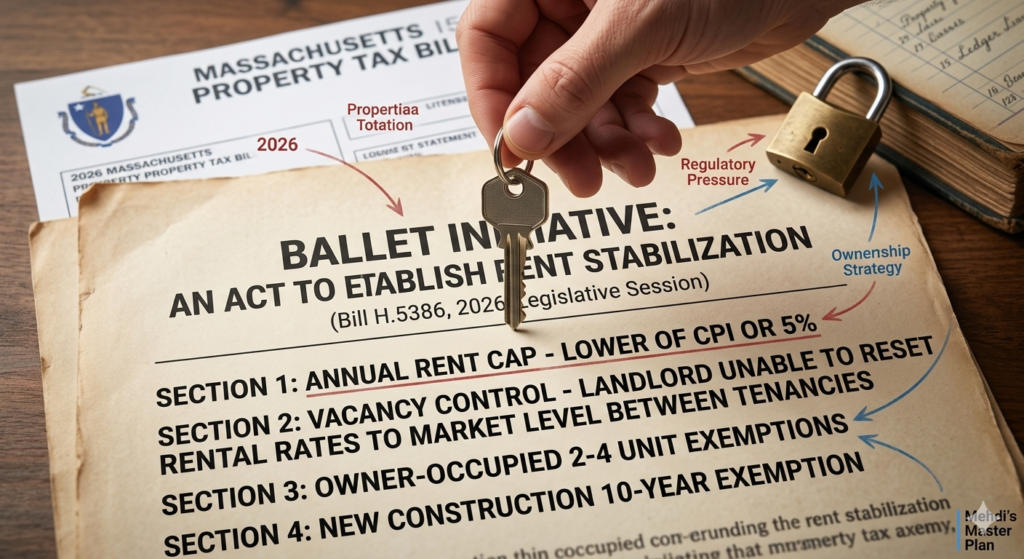
- The Cap: The initiative would cap annual rent increases at the Consumer Price Index (CPI) or 5%, whichever is lower. If inflation sits at 3%, your maximum allowable rent hike is 3%.
- The Base Rent Catch: The measure sets January 31, 2026, as the look-back base rent date. If a unit was occupied on that date, that rent is the anchor. If it was vacant, the most recent historic rental rate applies.
- Vacancy Control: Crucially, this policy features strict vacancy control. The cap applies even after a tenant vacates a unit. A landlord cannot reset the apartment to full market rate between tenancies.
The Key Exemptions (Where the Strategy Lies)
To avoid chilling new development entirely, the petition carves out specific exceptions:
- The 10-Year Runway: Newly constructed residential buildings are exempt from the rent cap for their first 10 years following completion.
- The Small Landlord Carveout: Owner-occupied multi-family properties with 4 or fewer units (such as classic three-deckers or duplexes where the owner lives in one unit) are entirely exempt.
3. The Master Plan Playbook: How to Position Your Portfolio
If you own an investment property on the South Shore, or if you are looking to buy your first multi-family home, you cannot afford to wait until November to see how the state votes. You need to structure your assets defensively right now.
Play #1: Focus on Owner-Occupied Multi-Families
The “house hack” has always been a smart move, but under the proposed 2026 framework, it becomes an elite asset class. By occupying one unit of a 2-to-4-unit property, you legally shield your building from the rent stabilization restrictions. This preserves your long-term valuation, gives you full market flexibility, and allows you to build equity completely unimpeded by local price controls.
Play #2: Lean Into the “By-Right” ADU Framework
If you own a single-family home with a significant lot, building an Accessory Dwelling Unit (ADU) or “in-law suite” is an exceptional way to manufacture secondary cash flow. Because these units typically serve family members or function as close-quarters rentals on an owner-occupied lot, they provide a flexible, highly protected stream of value that helps offset modern mortgage costs without exposing you to institutional landlord regulations.
Play #3: Audit Your Current Operational Expenses
If you own non-exempt rental property, you need to audit your operational costs immediately. Because rent caps limit gross revenue, unexpected capital expenditures (like a failing 20-year-old heating system) can completely wipe out your cash flow for years. Prioritize asset preservation now: update core mechanicals, ensure structural envelopes are tight, and lock in predictable maintenance expenses while the regulatory landscape is clear.
The Bottom Line
Winning in real estate requires recognizing where the market is going, not where it used to be. Whether you are trying to maximize the sale of a meticulously renovated home or analyzing the long-term yield of a multi-family asset, success comes down to a clear understanding of building mechanics and state policy.
Want a precise site-analysis of your property’s expansion potential or a current evaluation of your multi-family asset? Let’s connect and look at the plans.